Showing posts with label grapefruit. Show all posts

Wednesday, June 16, 2010

Grape


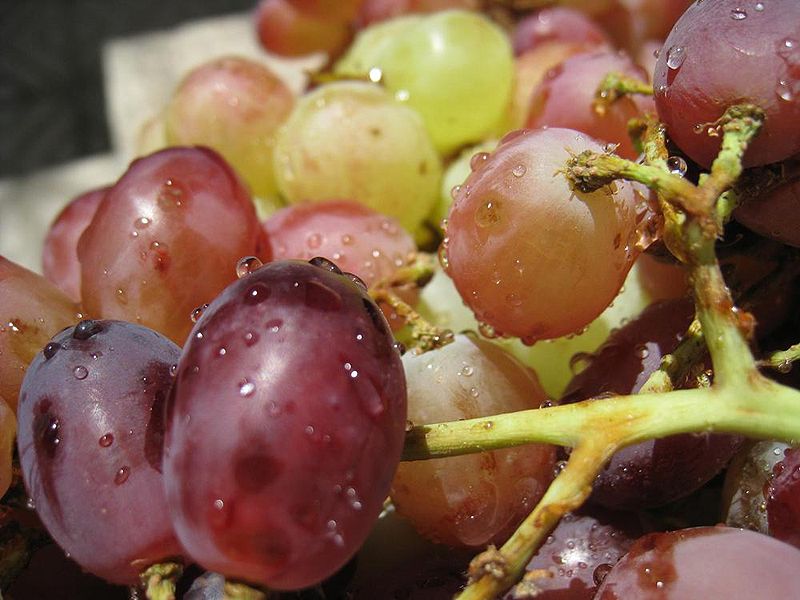
A grape is the non-climacteric fruit, botanically a true berry, that grows on the perennial and deciduous woody vines of the genus Vitis. Grapes can be eaten raw or used for making jam, juice, jelly, vinegar, drugs, wine, grape seed extracts, raisins, and grape seed oil. Grapes are also used in some kinds of confectionery.

The domestication of purple grapes originated in what is now southern Turkey. Yeast, one of the earliest domesticated microorganisms, occurs naturally on the skins of grapes, leading to the innovation of alcoholic drinks such as wine. Ancient Egyptian hieroglyphics record the cultivation of purple grapes, and history attests to the ancient Greeks, Phoenicians and Romans growing purple grapes for both eating and wine production. Later, the growing of grapes spread to Europe, North Africa, and eventually North America.

Native purple grapes belonging to the Vitis genus proliferated in the wild across North America, and were a part of the diet of many North American Native Americans, but were considered by European colonists to be unsuitable for wine. The first Old World Vitis vinifera purple grapes were cultivated in California where Spain had established a series of monasteries along the coasts to supply their navies with oranges to prevent scurvy and convert natives. Grapes have always had a part in history. There are old greek troughs and coffins in the Getty Villa, and they show cherubs in tubs of grapes, making wine.

Description

Grapes grow in clusters of 6 to 300, and can be crimson, black, dark blue, yellow, green and pink. "White" grapes are actually green in color, and are evolutionarily derived from the purple grape. Mutations in two regulatory genes of white grapes turn off production of anthocyanins which are responsible for the color of purple grapes.[1] Anthocyanins and other pigment chemicals of the larger family of polyphenols in purple grapes are responsible for the varying shades of purple in red wines

Grapevines

Most grapes come from cultivars of Vitis vinifera, the European grapevine native to the Mediterranean and Central Asia. Minor amounts of fruit and wine come from American and Asian species such as:

* Vitis labrusca, the North American table and grape juice grapevines (including the concord cultivar), sometimes used for wine. Native to the Eastern United States and Canada.
* Vitis riparia, a wild vine of North America, sometimes used for winemaking and for jam. Native to the entire Eastern U.S. and north to Quebec.
* Vitis rotundifolia, the muscadines, used for jams and wine. Native to the Southeastern United States from Delaware to the Gulf of Mexico.
* Vitis amurensis, the most important Asian species.

According to the Food and Agriculture Organization (FAO), 75,866 square kilometres of the world are dedicated to grapes. Approximately 71% of world grape production is used for wine, 27% as fresh fruit, and 2% as dried fruit. A portion of grape production goes to producing grape juice to be reconstituted for fruits canned "with no added sugar" and "100% natural". The area dedicated to vineyards is increasing by about 2% per year.

The following table of top wine-producers shows the corresponding areas dedicated to grapes for wine making

Sunday, December 13, 2009

Grapefruit


The grapefruit is a subtropical citrus tree known for its bitter fruit, an 18th-century hybrid first bred in Jamaica.When found in Barbados it was named the "forbidden fruit";it is also called the "shaddock", after its creator.

These evergreen trees are usually found at around 5–6 metres (16–20 ft) tall, although they can reach 13–15 metres (43–49 ft). The leaves are dark green, long (up to 150 mm, or 6 inches) and thin. It produces 5 cm (2 in) white four-petaled flowers. The fruit is yellow-orange skinned and largely oblate, and ranges in diameter from 10–15 cm. The flesh is segmented and acidic, varying in color depending on the cultivars, which include white, pink and red pulps of varying sweetness. The 1929 US Ruby Red (of the Redblush variety) has the first grapefruit patent.

The fruit has only become popular from the late 19th century; before that it was only grown as an ornamental plant. The US quickly became a major producer of the fruit, with orchards in Florida, Texas, Arizona, and California. In Spanish, the fruit is known as toronja or pomelo.

One ancestor was the Jamaican sweet orange (Citrus sinensis); the other was the Indonesian pomelo (Citrus maxima). Captain Shaddock brought pomelo seeds to Jamaica and bred the first fruit.

The hybrid fruit was in 1750 documented by the Rev. Griffith Hughes describing specimens from Barbados.Currently, the grapefruit is said to be one of the "Seven Wonders of Barbados."It was brought to Florida by Count Odette Philippe in 1823 in what is now known as Safety Harbor. Further crosses have produced the tangelo (1905), the minneola (1931), and the sweetie (1984). The sweetie has very small genetic and other differences from pomelo.

The grapefruit was known as the shaddock or shattuck until the 1800s. Its current name alludes to clusters of the fruit on the tree, which often appear similar to grapes.Botanically, it was not distinguished from the pomelo until the 1830s, when it was given the name Citrus paradisi. Its true origins were not determined until the 1940s. This led to the official name being altered to Citrus × paradisi.

The 1929 Ruby Red patent was associated with real commercial success, which came after the discovery of a red grapefruit growing on a pink variety. Only with the introduction of the Ruby Red did the grapefruit transform into a real agricultural success. The Red grapefruit, starting with the Ruby Red, has even become a symbolic fruit of Texas, where white "inferior" grapefruit were eliminated and only red grapefruit were grown for decades. Using radiation to trigger mutations, new varieties were developed to retain the red tones which typically faded to pink,the Rio Red variety is the current (2007) Texas grapefruit with registered trademarks Rio Star and Ruby-Sweet, also sometimes promoted as "Reddest" and "Texas Choice".

The Florida Department of Citrus stated "the primary varieties of Florida grapefruit are Ruby Red, Pink, Thompson, Marsh and Duncan. The fresh grapefruit season typically runs from October through June."

Grapefruit comes in many varieties, determinable by color, which is caused by the pigmentation of the fruit in respect of both its state of ripeness and genetic bent.The most popular varieties cultivated today are red, white, and pink hues, referring to the internal pulp color of the fruit. The family of flavors range from highly acidic and somewhat bitter to sweet and tart. Grapefruit mercaptan, a sulfur-containing terpene, is one of the substances which has a strong influence on the taste and odor of grapefruit, compared with other citrus fruits

Grapefruit can have a number of interactions with drugs, often increasing the effective potency of compounds. Grapefruit contains naringin, bergamottin and dihydroxybergamottin, which inhibit the protein isoform CYP3A4 predominately in the small intestine, but at higher doses, hepatic CYP3A4 inhibition is present as well.It is via inhibition of this enzyme that grapefruit increases the effects of a variety of drugs by increasing their bioavailability.The effect of grapefruit juice with regard to drug absorption was originally discovered in 1989. However, the effect became well-publicized after being responsible for a number of deaths due to overdosing on medication.

Grapefruit juice may be the first documented, but apple and orange juices have been also implicated in interfering with etoposide, a chemotherapy drug, some beta blocker drugs used to treat high blood pressure, and cyclosporine, taken by transplant patients to prevent rejection of their new organs.

Unlike other fruits grapefruit contains a large amount of naringin, and it can take up to 72 hours before the effects of the naringin on the CYP3A4 enzyme is seen. This is particularly problematic due to the fact that only 4 oz of grapefruit contain enough naringin to inhibit substrates of

Grapefruit is an excellent source of many nutrients and phytochemicals that contribute to a healthy diet. Grapefruit is a good source of vitamin C, pectin fiber, and the pink and red hues contain the beneficial antioxidant lycopene.Studies have shown grapefruit helps lower cholesterol and there is evidence that the seeds have high levels of antioxidant properties.Grapefruit forms a core part of the "grapefruit diet", the theory being that the fruit's low glycemic index is able to help the body's metabolism burn fat.

Grapefruit seed extract has been claimed to have strong antimicrobial properties, with proven activity against bacteria and fungi. However, no studies have demonstrated any efficacy by grapefruit seed extract as an antimicrobial for either bacteria or fungi. Additionally, although GSE is promoted as a highly effective plant-based preservative by some natural personal care manufacturers, studies have shown that the apparent antimicrobial activity associated with GSE preparations is merely due to contamination with synthetic preservatives.

A 2007 study found a correlation between eating a quarter of grapefruit daily and a 30% increase in risk for breast cancer in post-menopausal women. The study points to the inhibition of CYP3A4 enzyme by grapefruit, which metabolizes estrogen.However, there is a study showing that grapefruit consumption may not increase breast cancer risk. Furthermore, related studies showed a significant decrease in breast cancer risk with greater intake of grapefruit in women who never used hormone therapy.